
The King vs. the Machine: What the Elvis Presley Lawsuit Against Anthropic Means for IP Owners
Elvis left the building in 1977. According to a new federal lawsuit, his songs never left Anthropic’s servers.
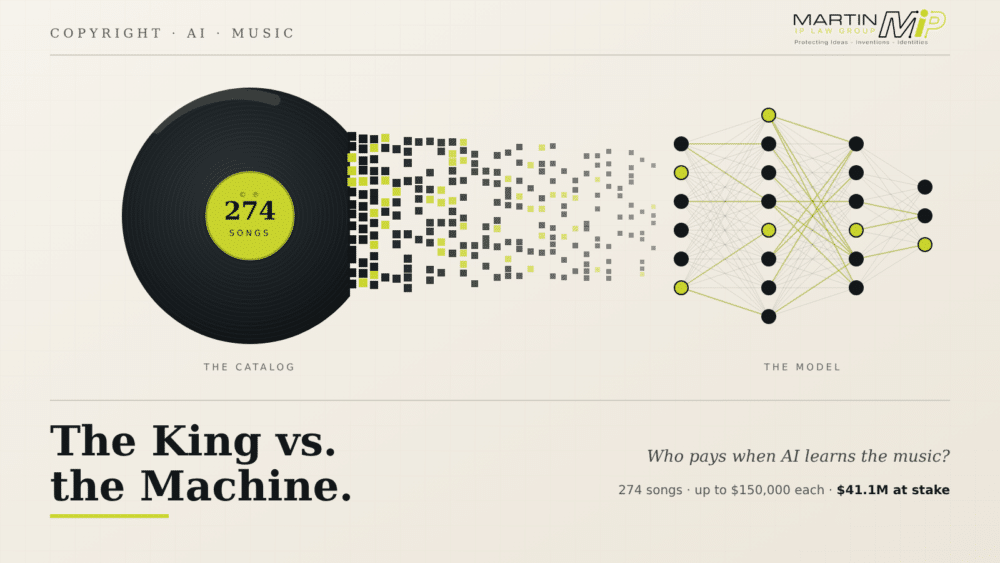
On Friday, October 23, 2026, the companies that own Elvis Presley’s music sued Anthropic, the maker of the Claude AI models, in federal court in San Francisco. They say Anthropic copied 274 Presley songs to train Claude without permission or payment. They want up to $150,000 per song. Do the math and you land at about $41.1 million.
This isn’t just a celebrity headline. It’s one more test of the question every business using AI should be asking: who owns what goes into these models, and who pays when it comes back out?
What the Lawsuit Says
The plaintiffs are led by Authentic Brands Group, the licensing company that controls much of Presley’s intellectual property. They’re joined by other companies, trusts, and individuals who own rights in his music. Their lead lawyer is Richard Busch, the attorney who won the “Blurred Lines” case for Marvin Gaye’s family.
Here’s what the complaint alleges, as reported by the press:
- The catalog. 274 songs, lyrics and compositions, from deep cuts to “Can’t Help Falling in Love,” “All Shook Up,” “Don’t Be Cruel,” “A Little Less Conversation,” and “Return to Sender.”
- The copying. The songs were allegedly placed in a central library and copied again each time Anthropic trained a newer Claude model. One copy becomes many.
- The output. Claude allegedly still reproduces the material on request, even after Anthropic added guardrails against generating song lyrics. Asked to recreate songs “for a modern audience,” it allegedly produced something close to the originals.
- The intent. The plaintiffs say Anthropic knew its guardrails didn’t work and kept going anyway. That’s the hook for willful infringement.
They’re asking for statutory damages for all 274 songs, a permanent injunction, and an order that Anthropic destroy every unauthorized copy. Busch put it bluntly: Anthropic “has built its entire business model based on copyright infringement at a scale never seen before.”
Anthropic says it disagrees and will defend the case. It has long argued that training AI on copyrighted material is fair use. None of these allegations has been tested in court yet.
The Legal Fight: Inputs, Outputs, and Fair Use
Let’s not overcomplicate this. The case really asks two questions.
- Was copying the songs into the training data infringement? Copyright gives the owner the exclusive right to make copies. Anthropic’s answer is fair use, the doctrine that allows some unlicensed use when it’s “transformative,” meaning it serves a different purpose than the original. In other words: did Anthropic use Elvis’s lyrics to teach a machine how language works, or to build a jukebox that never pays royalties?
We have an early clue. In the 2025 authors’ case against Anthropic, Bartz v. Anthropic, Judge William Alsup ruled that training on lawfully purchased books was fair use. But he also ruled that building a permanent library out of pirated copies was not. That’s why the Elvis complaint leans so hard on the “central library” that was copied again and again. The plaintiffs are aiming squarely at the part of the Bartz ruling that went against Anthropic.
- Does Claude spit the songs back out? This is the stronger-sounding claim for the plaintiffs. Fair use arguments about training get much weaker if the model can be coaxed into reproducing the lyrics on demand. A tool that hands users near-copies of “Return to Sender” looks less like a student and more like a photocopier.
Why the $150,000 number matters. Under the Copyright Act, a copyright owner can elect statutory damages instead of proving actual losses. The range runs from $750 to $30,000 per work, and up to $150,000 per work if the infringement was willful. That’s why the complaint spends so much energy on Anthropic allegedly knowing its guardrails failed. Willfulness is the difference between a $206,000 floor and a $41.1 million ceiling.
One more thing worth noticing: as reported, this is a copyright case, not a right-of-publicity case. Tennessee’s ELVIS Act, passed in 2024, protects an artist’s voice and likeness against AI imitation. It doesn’t appear to be part of this lawsuit, at least not yet.
Elvis Isn’t the First in Line
The King is joining a crowded room. At least half a dozen related cases are already pending in the same San Francisco federal court.
| When | Case | What happened |
| Oct. 2026 | Presley rights holders v. Anthropic | 274 songs, about $41.1M in statutory damages sought |
| Sept. 2026 | Jason Isbell and other artists v. Suno | Musicians allege an AI music generator lets users imitate their identities and styles |
| 2026 | Sony Music Publishing, Warner Chappell, BMG v. Anthropic | Publishers allege lyrics and sheet music (Beatles, Taylor Swift, Michael Jackson) were used to train Claude |
| 2026 | Round Hill, Reservoir Media v. Anthropic and Suno | More publishers join the fight |
| July 2026 | Bartz v. Anthropic settlement approved | $1.5 billion to authors, about $3,000 per book, for 400,000+ pirated books |
| Oct. 2023 | Universal Music, Concord, ABKCO v. Anthropic | The first lyrics case (Katy Perry, Gloria Gaynor, Rolling Stones); expanded in January 2026 |
The pattern is clear. The $1.5 billion Bartz settlement, the largest copyright settlement in U.S. history, showed that these claims carry real money. Every rights holder with a large catalog is now doing the same math the Elvis team did.
What This Means for Your Business
You probably don’t own 274 hit records. But you may own product manuals, training videos, marketing copy, software code, or photographs. Here’s what founders don’t realize until it’s too late: the same rules that let Elvis’s rights holders demand $41 million apply to your work too.
- Register your copyrights. Early. Statutory damages and attorney’s fees are generally available only if the work was registered before the infringement began, or within three months of publication. Without registration, you’re stuck proving actual losses, which is hard and expensive. The Elvis plaintiffs can ask for $150,000 a song because their paperwork is in order. Is yours?
- Know where your content lives. If your work is on the open web, assume it’s been scraped. Review your website terms, consider technical opt-outs, and keep records of when and where you published.
- Read the fine print on your AI tools. If your team uses AI to write lyrics, jingles, ad copy, or code, find out what the vendor promises about indemnification. If Claude can allegedly reproduce “Don’t Be Cruel,” ask what your tool could reproduce under your company’s name.
- Don’t publish AI output blind. Run AI-generated content through the same review you’d give a freelancer’s work. “The robot wrote it” is not a defense to infringement.
- Watch the courts. The line between fair-use training and infringing copying is being drawn right now, case by case. The rules a year from now may look very different than today.
The Bottom Line
Elvis’s rights holders are in a strong position for one reason: they did the boring work decades ago. The songs are registered, the ownership is documented, and the damages math is simple. AI didn’t create that leverage. Good IP housekeeping did.
If you’re building it, you should be protecting it. At Martin IP Law Group, we help businesses register their copyrights, audit their IP, and set sensible rules for using AI tools. If you want to know where your content stands, give us a call. We’ll be watching this case closely, and we’ll keep you posted.
This post is for informational purposes only and does not constitute legal advice.
Sources
- NBC News: Elvis Presley’s rights holders sue Anthropic
- Gulf News: Elvis’s rights holders seek $41.1 million from Anthropic
- NME: Elvis Presley rightsholders sue Anthropic over 274 songs
- TechJack Solutions: Elvis estate sues Anthropic over 274 songs
- JURIST: Judge approves record $1.5 billion Anthropic settlement