
When a Partnership Pitch Becomes a Trade Secret Lawsuit: DynamoEdge v. Andretti
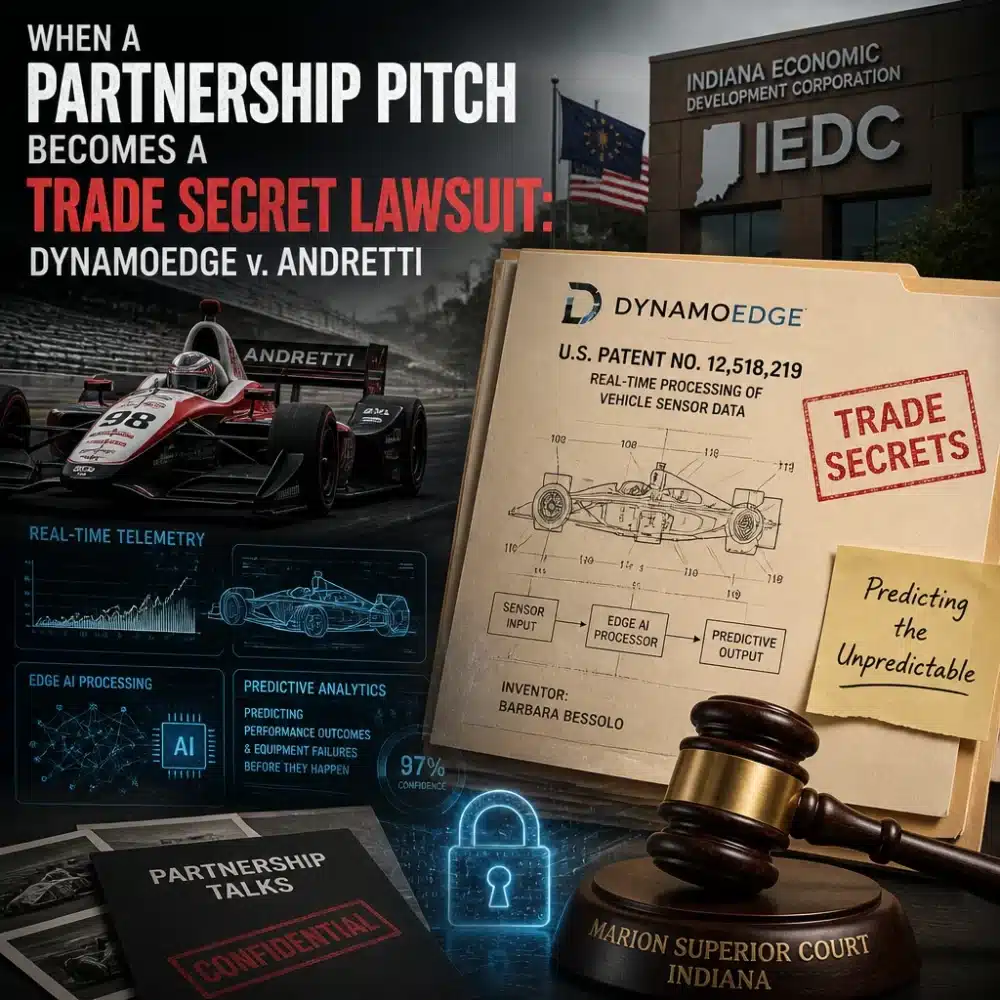
Every IP lawyer has heard some version of this story from a founder: we shared our technology with a bigger, better-connected partner during “partnership talks,” the deal fell apart, and a few years later our idea showed up inside someone else’s billion-dollar company. Usually the facts are murkier than the founder’s telling. But when the allegations land in a filed complaint, with a granted patent number attached and a state economic development agency named as a defendant, the story becomes a useful case study regardless of how it ultimately resolves.
That is exactly what happened on March 5, 2026, when Barbara Bessolo, founder and CEO of the Carmel, Indiana-based startup DynamoEdge, filed suit in Marion Superior Court against Michael Andretti, Andretti Autosport Holding Company, Andretti Global, the Indiana Economic Development Corporation (IEDC), former IEDC chief innovation officer David Roberts, Indy Autonomous Challenge founder Paul Mitchell, contractor 9-12 LLC, Palantir Technologies, the Applied Research Institute/Indiana Innovation Institute, and more than a dozen additional individuals and entities.
The technology at the center of the dispute
DynamoEdge builds real-time “edge AI” for motorsports telemetry — software designed to process vehicle sensor data on the fly and predict performance outcomes and equipment failures before they happen. The complaint centers on U.S. Patent No. 12,518,219, which DynamoEdge filed for in May 2022 and which was granted in early 2026, covering real-time processing of vehicle sensor data. Bessolo also claims common-law rights in the phrase “Predicting the Unpredictable,” which she says DynamoEdge has used as a slogan since around 2021.
How the relationship allegedly unraveled
According to the complaint and subsequent reporting, the story begins in October 2020, when DynamoEdge entered partnership discussions with Andretti. Bessolo alleges Andretti agreed to rebrand the company as “AndrettiEdge” and brought her into investor meetings with AT&T. Around 2021, DynamoEdge also held a subcontract with 9-12 LLC, which was terminated that September. A May 2021 matching-grant agreement between 9-12 and DynamoEdge was reportedly canceled within weeks of being signed.
Bessolo alleges that David Roberts, in his IEDC role, undermined her relationships with prospective partners including Cisco and AT&T, at one point allegedly telling her the technology was “never going to be at IMS” — a reference to the Indianapolis Motor Speedway. By 2024, Andretti had launched an AI venture reported to be valued at roughly $1 billion, which the complaint alleges incorporates DynamoEdge’s vehicle-performance-prediction technology and marketing language. The complaint also points to a 5G proof-of-concept project involving 9-12 LLC, AT&T, and Purdue University as another avenue through which DynamoEdge’s IP allegedly ended up in other hands.
The legal theories
The complaint reportedly pleads several distinct causes of action rather than a single trade secret claim, which is worth noting for anyone tracking how these disputes get pleaded in practice: misappropriation of trade secrets, breach of contract, tortious interference, defamation, and a claim for an accounting of IEDC contracts and grants dating back to 2016. That last piece is unusual — Bessolo’s team is effectively asking the court to require a public agency to open its books, on the theory that public funds may have supported ventures built on her technology without authorization. She is seeking exemplary and punitive damages along with an injunction barring further use of the disputed IP, trademarks, and technology.
Roberts, through his attorney Paul Jefferson, has already pushed back publicly, characterizing the suit as resting on “a fundamental lack of knowledge of the facts.” None of the defendants have been found liable, and the case is still in its early stages.
Why this case is worth watching
Setting aside how the facts eventually shake out, the fact pattern touches several issues that come up constantly in technology partnership deals: what happens when a startup shares proprietary technology during unsigned “partnership” discussions with a larger, better-resourced counterparty; whether a slogan or brand phrase used consistently in commerce can support common-law trademark rights; how patent prosecution timing (a 2022 filing, a 2026 grant) interacts with allegations of use that predate issuance; and the added complexity of layering a public-private economic development relationship — with grants, subcontracts, and a state agency’s own conflict-of-interest exposure — on top of an ordinary commercial dispute.
For founders, the practical lesson is the same one IP counsel gives in every deal-stage conversation: get the NDA and any IP assignment or license terms in writing before the pitch, not after the rebrand discussion; file for patent protection early rather than relying on trade secret status alone once a technology is being shopped around to partners; and document who said what, and when, because years later those details are exactly what a complaint like this one is built on.
We’ll continue to monitor this case as it proceeds through Marion Superior Court.
This post summarizes publicly reported allegations from a filed civil complaint. The claims described above are allegations only and have not been proven in court.
Sources
- DynamoEdge Initiates Lawsuit Against Andretti and Multiple Parties Over Alleged Misappropriation of AI Vehicle Performance Technology — IIPLA
- Carmel tech firm sues IEDC, others over alleged IP theft — The Indiana Lawyer
- Carmel Tech Founder Says State Insiders Hijacked Her Racing AI — Hoodline
- Andretti hit with major lawsuit over alleged technology theft — Formula 1
- IndyCar News: DynamoEdge sues Andretti and others over theft of intellectual property — Autoracing1