
Can You Use ChatGPT/Claude/Gemini While Inventing? What the Rule Against “AI Inventors” Actually Requires
A question we’re hearing more and more from inventor clients goes something like this: I used AI tools throughout development — for research, for organizing my notes, for drafting business documents, for thinking through regulatory strategy. Does that create a problem for my patent application?
It’s a fair question, and it’s usually prompted by half-remembered headlines about Thaler v. Vidal — the case that made clear an AI system can’t be named as an inventor on a U.S. patent. That headline is accurate, but it answers a narrower question than most people think it does. Below is how we walk clients through it, using a recent (anonymized, and lightly composited) fact pattern as an illustration.
The scenario: The client’s product idea originated years earlier from the client’s own hands-on experience solving a personal problem. Long before any AI-assisted work began, the client had privately worked out the core mechanism themselves. The client also happened to have a timestamped chat log — from before any substantive development work — in which they described the concept, in their own words, to an AI assistant. From that point forward, the client used AI tools extensively: researching related art and regulatory questions, organizing findings, drafting business documents, and thinking through strategy. All physical testing and refinement was done by the client, by hand, on the actual product.
1. Does this create an inventorship problem, or a disclosure obligation?
Short answer: not on these facts, and here’s why.
Thaler v. Vidal held that under the Patent Act, an “inventor” must be a natural person — a machine can’t be listed as one. The Federal Circuit decided that in 2022, and the Supreme Court has since twice declined to disturb the underlying principle (denying certiorari in the original patent case, and again in the companion copyright dispute over AI-generated output). That rule is now settled.
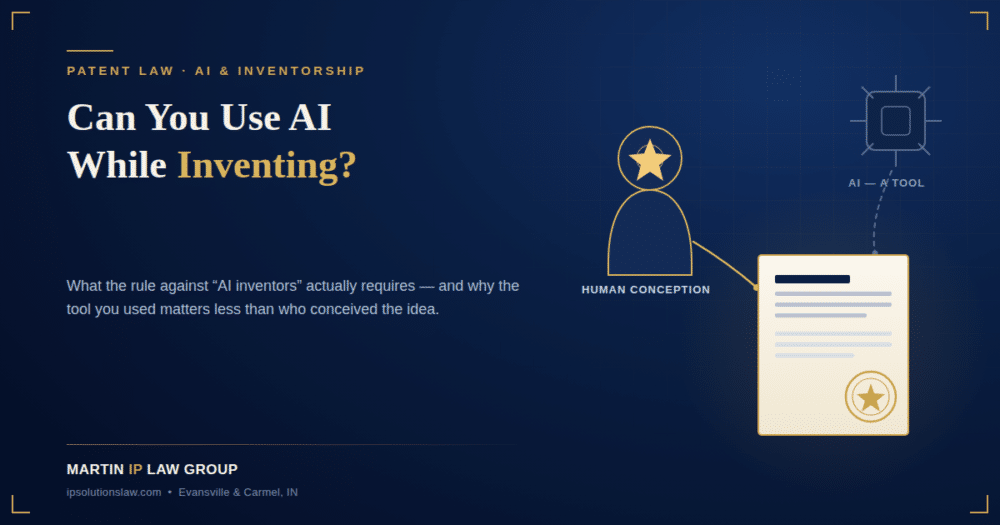
What it does not say is that using AI during the invention process disqualifies you as the inventor. The USPTO addressed that directly, first in 2024 guidance and then in a revised version issued in late November 2025 that simplified the standard considerably. The Office now applies a single, uniform inventorship test regardless of what tools were involved: did a natural person form the definite and permanent idea of the complete and operative invention? The 2025 revision explicitly frames AI as “a sophisticated tool, akin to a laboratory instrument” — the same category as a modeling program, a search database, or a bench assistant who follows instructions. Using a tool to research, organize, draft, or test doesn’t make the tool a co-inventor, any more than a word processor or a CAD program would be.
Applied to the scenario above: the conception — the actual inventive insight — occurred in the client’s own head, based on personal experience, and there’s a contemporaneous, timestamped record showing the concept was already fully formed before any AI involvement. Everything after that point — research, drafting, strategy discussions, and the physical testing that reduced the idea to practice — is exactly the kind of tool-assisted work the current guidance says doesn’t touch inventorship, provided the AI wasn’t the source of the inventive contribution itself. The one thing we’d always confirm with a client in this position: did the AI, at any point, propose a specific technical solution or design element — as opposed to organizing, summarizing, or explaining things the client already directed — that ended up in the claims? If so, that particular element deserves a closer look. Explaining well-understood concepts or executing on the inventor’s specific instructions doesn’t count as a contribution to conception; independently proposing a novel technical fix might.
As for disclosure: there’s no separate box to check telling the USPTO “I used AI.” What does apply is the ordinary duty of candor and good faith that already governs every filing — the Office’s April 2024 guidance made clear that duty extends to “the actions individuals take with any automated tools, including AI tools,” meaning anything AI-assisted that’s material to patentability has to be handled with the same honesty as anything else. Practically, that means two things: the inventor’s declaration (the sworn statement that you believe yourself to be the true inventor) has to remain accurate, which it is here; and nobody gets to treat AI output as pre-verified. If an AI tool is used anywhere near the substance of the application — drafting language, characterizing prior art, describing what the invention does — a human has to independently check it before it’s filed. The Office has been blunt that “simply relying on the accuracy of an AI tool is not a reasonable inquiry.”
A contrasting example — where it gets murkier
Not every AI-assisted development story is this clean, and it’s worth showing the other end of the spectrum so the line is clear. In a different (also anonymized and composited) matter, a founder came to us with a working prototype and a fairly polished specification, largely shaped by an AI tool from early on. Their process had been to describe the problem they wanted solved and ask the tool to propose a mechanism, then build around whatever it suggested. When we asked the founder to walk us through their own contribution to the core mechanism in the claims, the honest answer amounted to: recognizing that the AI’s suggestion would work, and then building it.
That’s a materially different fact pattern, and current guidance treats it as a real risk rather than a formality. Identifying a problem and prompting a tool to solve it, then appreciating that the tool’s proposed solution is a good one, generally isn’t enough to establish conception of that solution — a person has to have actually formed the definite and permanent idea of the claimed invention, not merely recognized the value of an idea that originated elsewhere. If no natural person can honestly say they conceived a given claim element, that element is on shaky ground: it can jeopardize the validity of the claim, and it puts the inventor’s signed declaration at real risk of being inaccurate.
Situations like this are usually recoverable, but not by adjusting the paperwork. The fix is substantive: go back and identify where the founder’s own independent judgment actually entered the process — a modification, a rejection of one AI-suggested approach in favor of another, a design constraint only the founder would know to apply — and build claims around what they can honestly stand behind as their own. Where there wasn’t much of that, the claims may need to be narrowed, or the invention may need further independent development before it’s ready to file. What doesn’t work is treating an AI-proposed mechanism as your own idea simply because you were the one who typed the prompt.
2. Documentation practices worth adopting going forward
None of this requires overhauling how a client works — it mostly means being deliberate about what gets recorded and when.
- Keep the conception record intact and separate. The dated, contemporaneous description of the idea — in the client’s own words, before AI-assisted development began — is exactly the kind of evidence that makes this analysis easy. Export it, preserve the metadata, and don’t let it get mixed in with later, more collaborative research threads.
- Maintain an ongoing inventor’s record. Dated notes, sketches, or a simple log of testing and iteration — kept independent of any AI tool — continues to be the strongest evidence of who actually conceived and refined the invention.
- When AI is used to brainstorm technical options, document the human judgment layer. If a client ever does ask an AI tool for possible solutions to a design problem, the record should show the client evaluating, selecting, modifying, and testing those options — not simply adopting an output wholesale. That evaluative work is itself evidence of inventive contribution.
- Verify before it’s filed. Any AI-touched language, citation, or technical characterization headed for the application should be independently checked against source material — both because of the duty of candor and because AI tools are known to occasionally fabricate or misstate details.
- Mind confidentiality, separately from inventorship. Before pasting unfiled invention details into a consumer-tier AI account, check the provider’s data-use settings. It’s less about patent law and more about not inadvertently sharing confidential technical information more broadly than intended.
The bottom line for clients using AI as part of an otherwise ordinary R&D and business-development process: the Thaler rule is about who — or what — can be named as an inventor, not about what tools an inventor is allowed to use along the way. Good habits around dating and preserving your own conception evidence do more to protect the application than any change in how AI is used.
This post discusses general principles of current U.S. patent law and USPTO guidance for informational purposes; it isn’t legal advice and doesn’t create an attorney-client relationship. The scenario described is a composite, anonymized illustration and doesn’t identify any client or specific matter. Every fact pattern is different — if you’re navigating a similar question, talk to counsel about your specific situation.