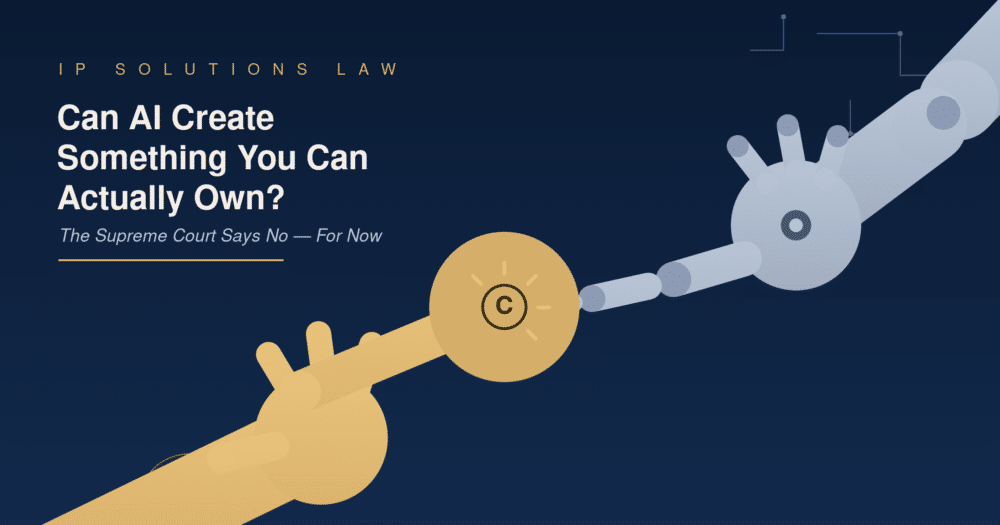
Can AI Create Something You Can Actually Own? The Supreme Court Says No — For Now
A client asked me last month whether the AI-generated product renderings her design team had been using could be protected as her company’s intellectual property. It’s a great question, and as of this spring, we finally have a clearer answer from the courts — even if it isn’t the one everyone wanted.
In March 2026, the U.S. Supreme Court declined to hear Thaler v. Perlmutter, letting stand a ruling that copyright law requires a human author. If you’re using AI in your business — and by now, most of us are, in one form or another — this case is worth five minutes of your time.
What Happened
Dr. Stephen Thaler, a computer scientist, applied for copyright registration on an image called “A Recent Entrance to Paradise,” which he said was generated entirely by his AI system, DABUS, with no human prompting, editing, or creative input at all. He was upfront about that — no human touched the creative process. The Copyright Office denied the application. The D.C. Circuit agreed with that denial. And on March 2, 2026, the Supreme Court declined to take the case, leaving the D.C. Circuit’s ruling in place.
The rule, in plain terms: a work produced entirely by a machine, with no human creative contribution, cannot be copyrighted. It doesn’t matter how original the output looks.
What This Case Didn’t Decide
Here’s the part I want my clients to understand, because it’s where the real-world stakes are. Thaler’s case was an extreme, deliberately clean test — he disclaimed any human involvement on purpose. The Court didn’t address the situation most businesses are actually in: a person using AI as a tool, prompting it, picking through outputs, editing results, or combining AI-generated pieces into something new.
That situation is governed by the Copyright Office’s own guidance, and it’s more workable than people assume. Here’s how I’d summarize it for clients:
AI-assisted work can be copyrighted if a human is genuinely exercising creative control — writing a piece and using AI to edit or polish it, for example, doesn’t put your authorship in doubt.
Selection and arrangement can count. If you select, arrange, or substantially modify AI-generated elements in a creative way, that arrangement can be protected — even if the individual AI-generated pieces, on their own, couldn’t be.
A prompt alone isn’t authorship. Typing a prompt into a generative AI tool, no matter how carefully crafted, doesn’t by itself make you the legal “author” of the output. The Office’s logic: identical prompts can produce very different results, which tells you the human isn’t controlling the actual expression — the AI is.
Pure AI output is not protectable. Full stop. If nothing about the final product reflects human creative judgment, it isn’t yours to copyright.
Why I’m Telling You This
If your business leans on generative AI for marketing content, product designs, written materials, or other creative assets, this matters more than it might seem. Content that’s essentially raw AI output — accepted as-is, without meaningful human editing or arrangement — may not be something you can actually stop a competitor from copying. No demonstrable authorship, no enforceable copyright.
It also affects how you should be filing. The Copyright Office now requires applicants to disclose AI’s role in a work and explain the human contribution specifically. I’ve seen clients try to skip past this on an application, and it’s not worth the risk — an inaccurate disclosure can undermine the registration itself, and with it, your ability to enforce the work down the line.
What I’d Recommend
Keep a record of the human creative process behind anything you want to protect: what was selected, edited, arranged, or substantially changed, and by whom. Treat AI output as a draft or raw material rather than a finished product if copyright protection is something you care about. And when you do register AI-assisted work, disclose the AI’s role honestly — the Copyright Office is actively looking at this, and it’s far better to get it right the first time.
Thaler may be the last word on purely autonomous AI authorship, but it’s really just the opening chapter on how the law will handle humans and AI working together, which is the situation nearly all of us are actually in. I’ll keep tracking how this develops. If you have questions about protecting AI-assisted work at your company, give me a call.
Rick Martin
IP Solutions Law
This post is for informational purposes only and does not constitute legal advice. If you have questions about protecting AI-assisted work, please contact us and schedule a strategy session.